
The ground-source heat pump system: Heating and cooling from your own floor
An borehole heat exchanger brings the constant temperature of the soil into the house: In winter it heats over a brine-to-water heat pump, in summer it cools passively. This page compares the system with the most common alternative (the air-to-water heat pump) and shows where geothermal energy fits and where it doesn’t.
geothermal energy or air heat pump?
The overall system counts for the investment: heat pump, heat source and installation. Over the useful life, both the efficiency and the service life of the components influence the economic efficiency.
| Concentration | Geothermal ( brine-water) | Air-to-water heat pump |
|---|---|---|
| Annual working number (YES) | 4,6 (48% higher) | 3,1 |
| Full cost over 25 years | 7,6 % cheaper | Reference value |
| Purchase | Total system including ground exploitation | Complete system including outdoor unit and installation |
| Heat source | Earth, almost constant temperature throughout the year | Outside air (coldest when the heat demand is greatest) |
| Passive cooling in summer | Yes, without compressor | No (cooling only active, with full power consumption) |
| Outer unit | none (no fan, no sound in the garden) | Ventilator unit outdoors |
| Authorisation | Check local specifications for drilling and installation | Check local setting and sound specifications |
| Durability and efficiency | Ground probe: at least 50 years. Brine-to-water heat pump: approx. 23 years. The long-lived earth probe remains usable as a heat source even in a later heat pump exchange. | Air-to-water heat pump: approx. 16 years. Equipment replacement and maintenance shall be considered in the long-term cost comparison. |
The cost of a geothermal plant does not simply result from the cost of an air-to-heat pump plant plus drilling. Depending on the system, the equipment costs can vary and work for an outdoor unit, its foundation or a refrigerant split unit can be omitted. Relevant is a comparison of the complete offers.
Earth probe, ring trench collector or geothermal basket?
If you have chosen geothermal energy, the next choice is the design of the heat source. The criteria that actually decide this choice:
| Concentration | Earth probe | Annular trench collector | Geothermal basket |
|---|---|---|---|
| Space requirements | Small drilling area, hardly any land use | large area, must remain free | Medium area, several baskets needed |
| Heat source | Constant temperature throughout the year | Near-surface, seasonally fluctuating | Near-surface, seasonally fluctuating |
| Efficiency | highest and stable over the year | fluctuates with outside temperature | fluctuates with outside temperature |
| Intervention | Examine local specifications | Excavation over the entire area | Multiple pits |
| Possible afterwards | Yes, even with an existing garden | only for open, undeveloped area | Limited |
The Earth probe brings its heat from a depth where the temperature of the earth remains constant throughout the year. Therefore, it maintains its efficiency precisely in the coldest weeks, when a near-surface collector is weakest. And it is the only one of the three types of construction that also works on a property that is already built, planted or sealed.
Where geothermal energy fits and where not
geothermal energy fits if ...
- You replace an existing heating and calculate in the long term, also in the Old building with radiators.
- the property permits access for a compact drilling rig. Thanks to 108-mm-borehole instead of 132 mm, little space is enough.
- You want to cool in the summer without running an air conditioner.
- the local conditions for a ground probe installation are met.
geothermal energy does not fit if ...
- ground probe drilling at the specific location is not permitted or technically impossible. The drill partner clarifies this before the offer.
- There is no access for a drill, not even for a compact one.
- Only the purchase budget counts: In the pure initial investment, the air-to-water heat pump remains cheaper.
Passive cooling works exclusively with geothermal energy or groundwater heat pumps.
An air-heat pump cannot provide this operation. She lacks the cool spring in summer.
The mechanism is simple: In summer, the soil is much cooler than the room air. The brine circulates through the earth probe and absorbs the room heat via the floor or wall heating. The compressor of the heat pump remains switched off. Only the circulating pump runs.
Cooling can also be possible without floor or wall heating: Suitable fan coils transfer the coolant into the room. With a high cooling requirement, active cooling with a running compressor comes into consideration. Which solution fits, is designed for the building.
The house is noticeably tempered, the excess heat flows back into the ground and regenerates the probe for the next winter. Cooling as a by-product of heating, without air conditioner, without outside unit.
Conditions
- Earth probe or groundwater mount as heat source
- Suitable cooling surfaces or fan coils. For existing radiators, the suitability must also be assessed on a case-by-case basis; Cooling performance and condensation water protection are part of the planning.
- a heat pump with passive cooling module
Basis of the regeneration data: design / system sizing of borehole heat exchangers according to SIA 384/6.
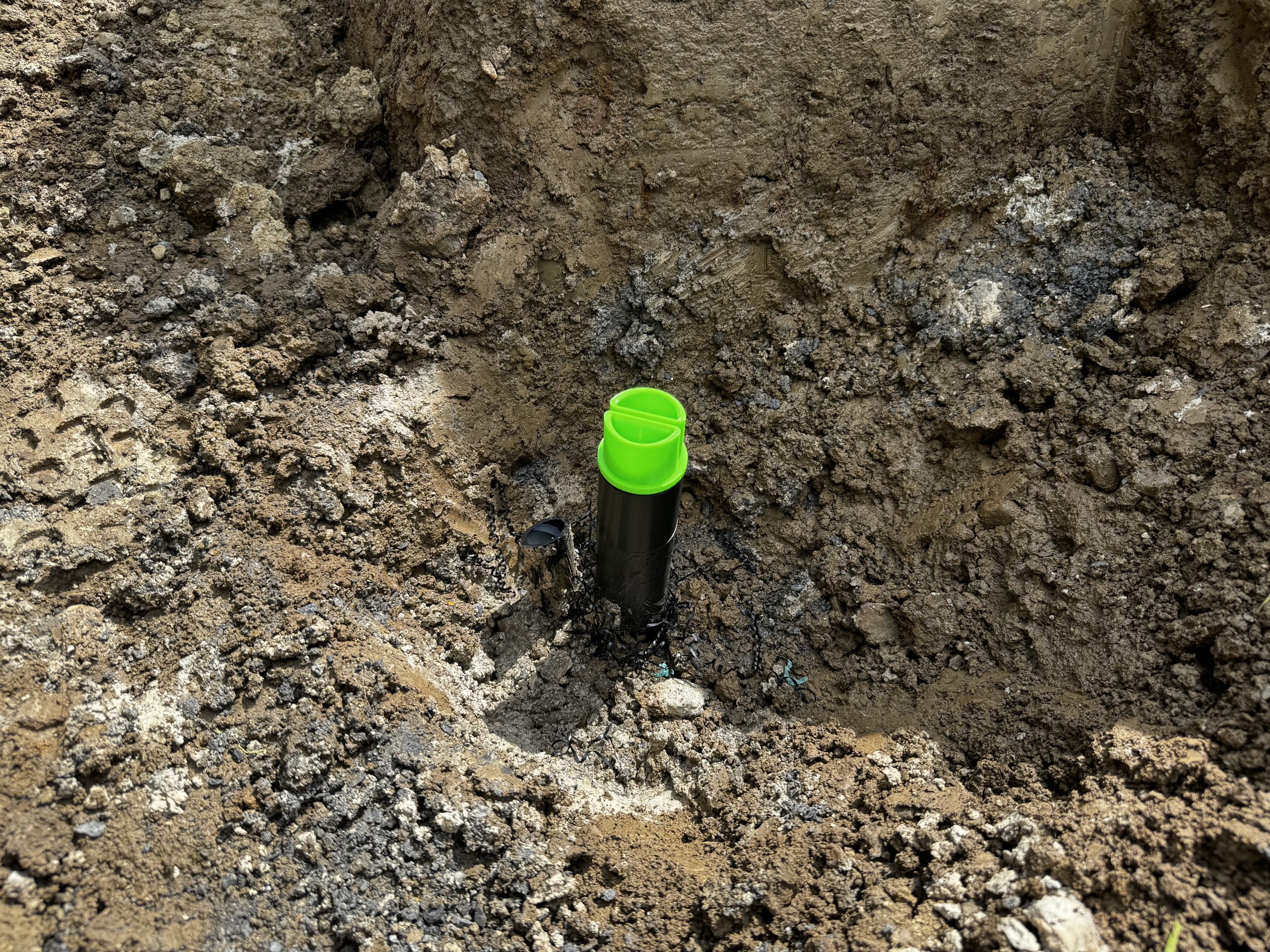
How the probe itself is constructed shows the Splitpipe product page.
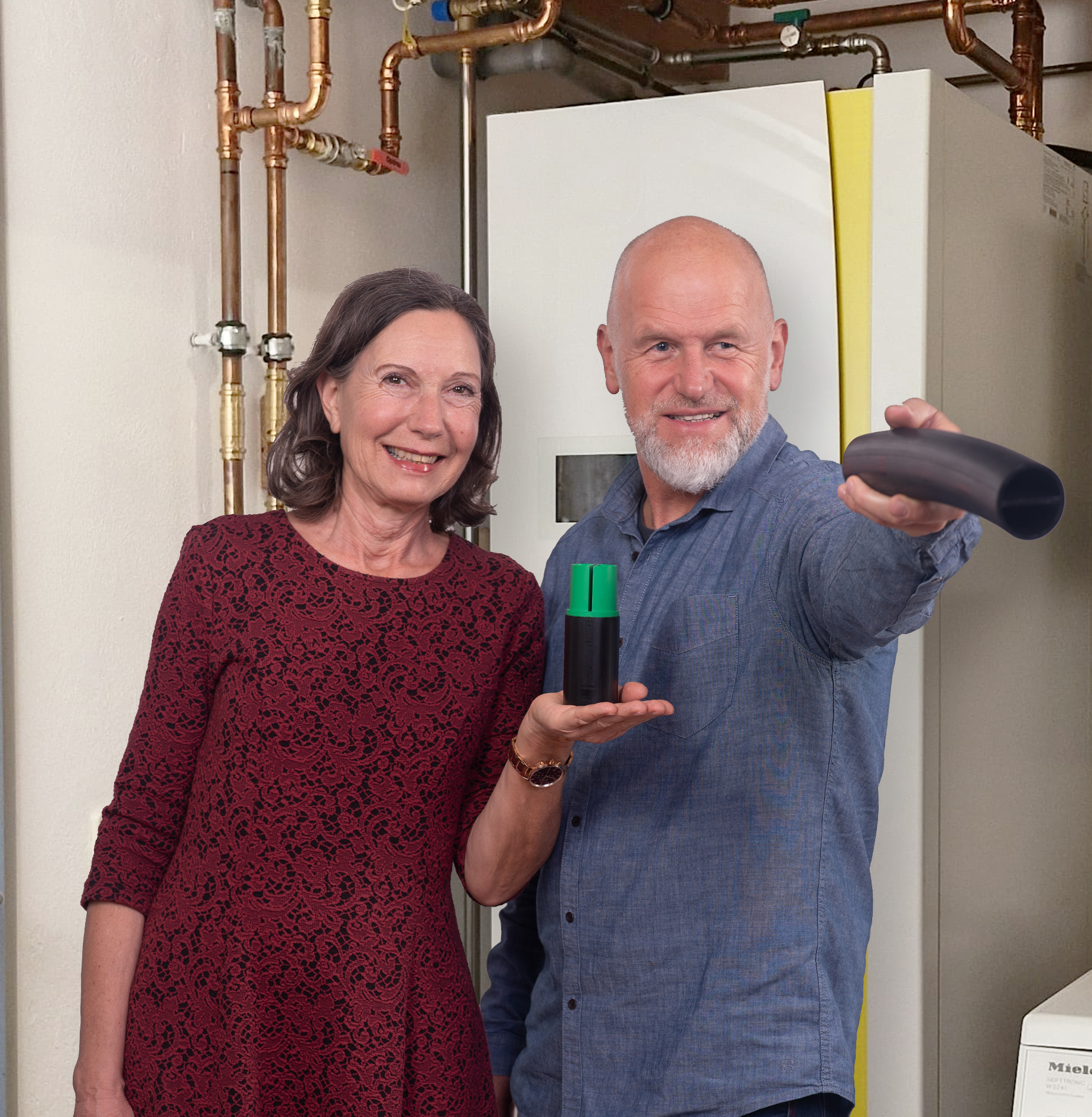
Some said that an air heat pump would be the cheapest for us. But separatus was able to present a convincing concept with geothermal energy, bottom line even cheaper. We are extremely satisfied and would do it again.
What makes the separatus system different
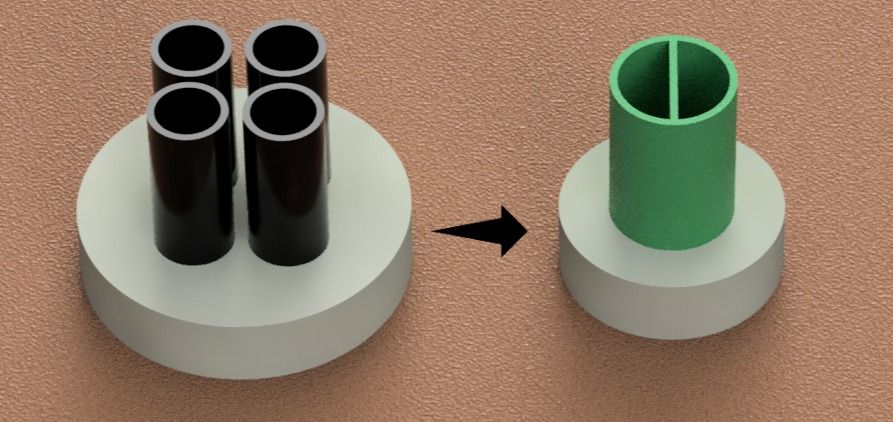
Conventional double-U probes need a 132 mm borehole. The split pipe carries forward and return flow in a single 51 mm two-chamber pipe. The borehole shrinks to 108 mm, the drilling tool at the same time. At 100 mm well, the efficiency is equivalent to a double U probe in the 132 mm well.
Less hole also means less material and fewer emissions on the construction site:
drill cuttings
−43 %
100 mm instead of 132 mm borehole
borehole grout / grouting material
−45 %
100 mm instead of 132 mm borehole
Diesel
−50 %
100 mm instead of 132 mm borehole
brine / heat transfer fluid filling
−35 %
51 mm probe versus double-U 32 irrespective of drilling diameter
Questions about ground-source heat pump system
Does an Earth probe bore need a permit?
It depends on the location. The requirements for approval, notification and proof vary by state, federal state and canton. The drill partner clarifies the local specifications before the offer and accompanies the necessary steps.
Does geothermal energy work in the old building with radiators?
Yes. The heat pump is dimensioned to the existing heaters and their flow temperature. Especially in the case of heating replacement in the existing building, the narrow bore plays out its advantage: garden, trees and terrace remain standing, the compact drilling tool still comes along. For cooling, suitable cooling surfaces or fan coil vectors are required.
How much space does the bore need?
Significantly less than with conventional probes: For the 108-mm-borehole of the Splitpipe (instead of 132 mm conventionally), a compact drilling rig with a small positioning and access area is sufficient. Whether your property is suitable, the drilling partner assesses on the basis of access, distances to the building and border as well as the permit situation.
What happens in a very cold winter?
Little. This is the core of the system. The soil at probe depth remains almost constant throughout the year, regardless of the outside air. This is why the geothermal heat pump maintains its efficiency precisely when an air-to-heat pump needs the most electricity because of cold outside air.
Can I also cool with the Earth probe?
Yes, passive: The brine circulates through the probe in summer and dissipates space heat into the ground, the compressor remains out. Details are in the section passive cooling on this side.
The system comparison in your own numbers
The cost page breaks down acquisition, drilling and operation, and the cost comparison calculator calculates the 25-year comparison for your building.
What Geothermal Energy Really Costs