Our experts are often asked: Does it matter if the pre- and return of a borehole heat exchanger (BHE) lie closely together? Do the strands not influence each other? This often leads to questions such as: “Does not the bridge of the separatus Splitpipe borehole heat exchanger (Splitpipe BHE) have a disadvantage?” In part 1 of this double article we try to answer the questions as simply and clearly as possible.
What is meant by “thermal short circuit”?
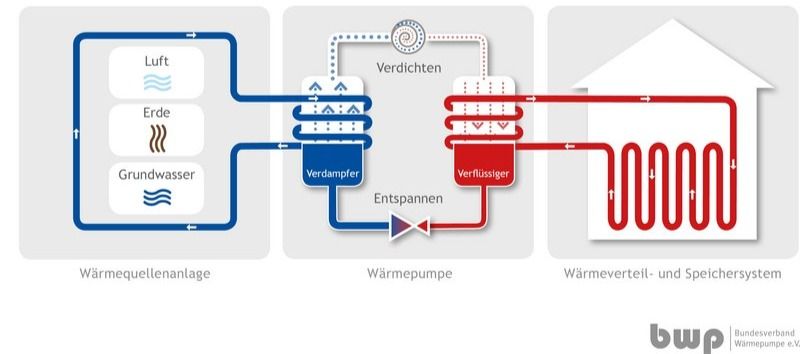
To answer this question, we are not spared a little theory course, we must briefly explain the general functioning of a heat pump: On the one hand, it extracts energy from a source to raise the temperature in the heat distribution system of the house on the other. For this purpose, a heat carrier (brine / heat transfer fluid, water, air) must constantly circulate on the source side (the left side in the picture below) in order to provide the required thermal energy. On the source side, a distinction is made between open and closed systems. Open systems are heat pumps that openly suck in the ambient air or groundwater and release it back there. In borehole heat exchangers, on the other hand, the heat carrier circulates in a closed pipe system which absorbs the ambient heat via heat conduction.
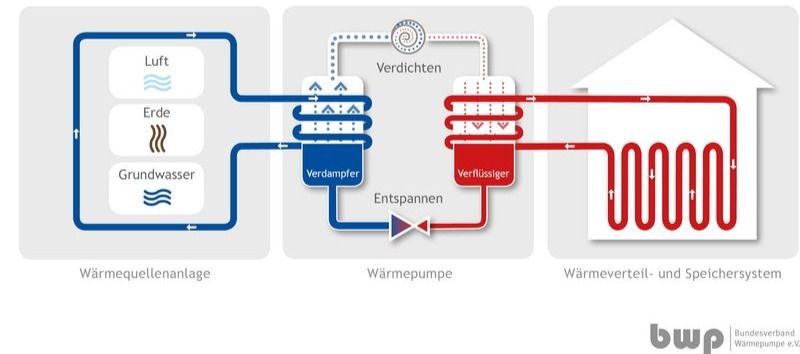
Operation of a heat pump
In open systems in particular, the following problem arises: an excessively small distance between suction and return leads to a short circuit. For example, the phenomenon occurs in air heat pumps when the cooled air is directly sucked in again or with only a small detour. The medium does not have the opportunity to be sufficiently warmed by the environment. The efficiency of such a heat pump goes to its knees.
Does such a short circuit also occur in closed systems?
In the closed pipe system of the borehole heat exchanger system, the medium cannot be directly sucked in again in a short circuit, it can only circulate the entire path through the borehole heat exchanger (BHE) until it reaches the heat pump again. However, the question arises again and again whether a heat transfer by means of heat conduction between the cold and the warm side in the soil can take place. This would also be equivalent to a thermal short circuit. Is there this effect? What does science say?
For a theoretical analysis, so-called CFD simulations are carried out today. A computational fluid dynamics (CFD) simulation is a numerical flow simulation carried out using a computer model that calculates the movement of the fluid in the borehole heat exchangers and represents heat transfer taking into account many complex phenomena. CFD simulations show that there are many factors in how heat conduction occurs within a borehole heat exchanger well.
Some of these factors have a strong impact, some weak. In particular, the thermal conductivities of the rock and the backfill material play a role. In addition, the flow conditions of the heat transfer medium (laminar or turbulent) and the heat transfers at the interfaces are of importance. And they agree: The position of the probe tubes within the borehole also makes a difference, because heat always flows from warm to cold, this physical law cannot be completely stopped. But how much can this affect the overall performance?
thermal short-circuiting: of what significance?
One of the largest studies carried out* shows that among all these factors, the choice of backfill material has one of the biggest impacts. In the next position she mentions the quality of the borehole grouting, the more conscientious the work, the higher the efficiency of the borehole heat exchanger (BHE). It also shows that the so-called “thermal well resistance” with a larger diameter tends to increase, i.e. the borehole heat exchanger (BHE) decreases in the heat transfer capacity. And the larger the selected borehole diameter, the stronger the impact of material selection and inferior processing.
It is interesting that the study also examined the use of probe tube spacers. Spacers were originally developed with the intention of separating the probe tubes from each other in order to reduce the thermal influence (short-circuit) among each other as much as possible. But what conclusion does the practical study come to? The use of spacers can paradoxically lead to increased borehole resistance due to an increased risk of water or air inclusions. Spacers must have been invented at the desk, you thought you could get the last percent out of a probe, but in practice they are counterproductive. Conclusion: The qualitative execution of the borehole heat exchanger drilling and the selection of thermally high-quality materials are much more important than a minimum thermal short-circuiting that may occur.
A comparison: Imagine you want to buy a thermal cup. A good thermal cup will keep coffee or tea hot for a long time. In the business are 2 models. The expensive cup advertises with a very thick insulation, but has no lid. The other is cheaper, the insulation a little thinner, but has a closing lid with it. Which cup will keep your coffee hot for longer? So what is important? To the individually considered insulation value of the cup wall or to the entire design?

Thermal cups
This is exactly how it is with a borehole heat exchanger (BHE): the total product counts. Minimal thermal conduction between Vor- and return is not crucial. Although a thermal short-circuiting is also theoretically given in a borehole heat exchanger (BHE), it is so small that it is hardly measurable. Crucially, the overall system is well planned: a slim bore, a good embedding of the probe, suitable hydraulics. On the whole, this counts much more than a small thermal short-circuiting in the soil, mathematically on the third decimal point.
At separatus, we attach great importance to a holistic planning and execution. The separatus partners stand for competence and quality. The planning recommendation for the separatus system: a drilling diameter as small as possible, thermally improved borehole grouting, turbulent flow.
In the next part of the double article, we show which studies on the separatus Splitpipe technology were made in detail. We present the results of CFD simulations carried out by the University of Applied Sciences OST, as well as analyses of borehole heat exchangers carried out in real operation.
* https://www.geoenergie-konzept.de/thermischer-bohrlochwiderstand
More pictures and videos