
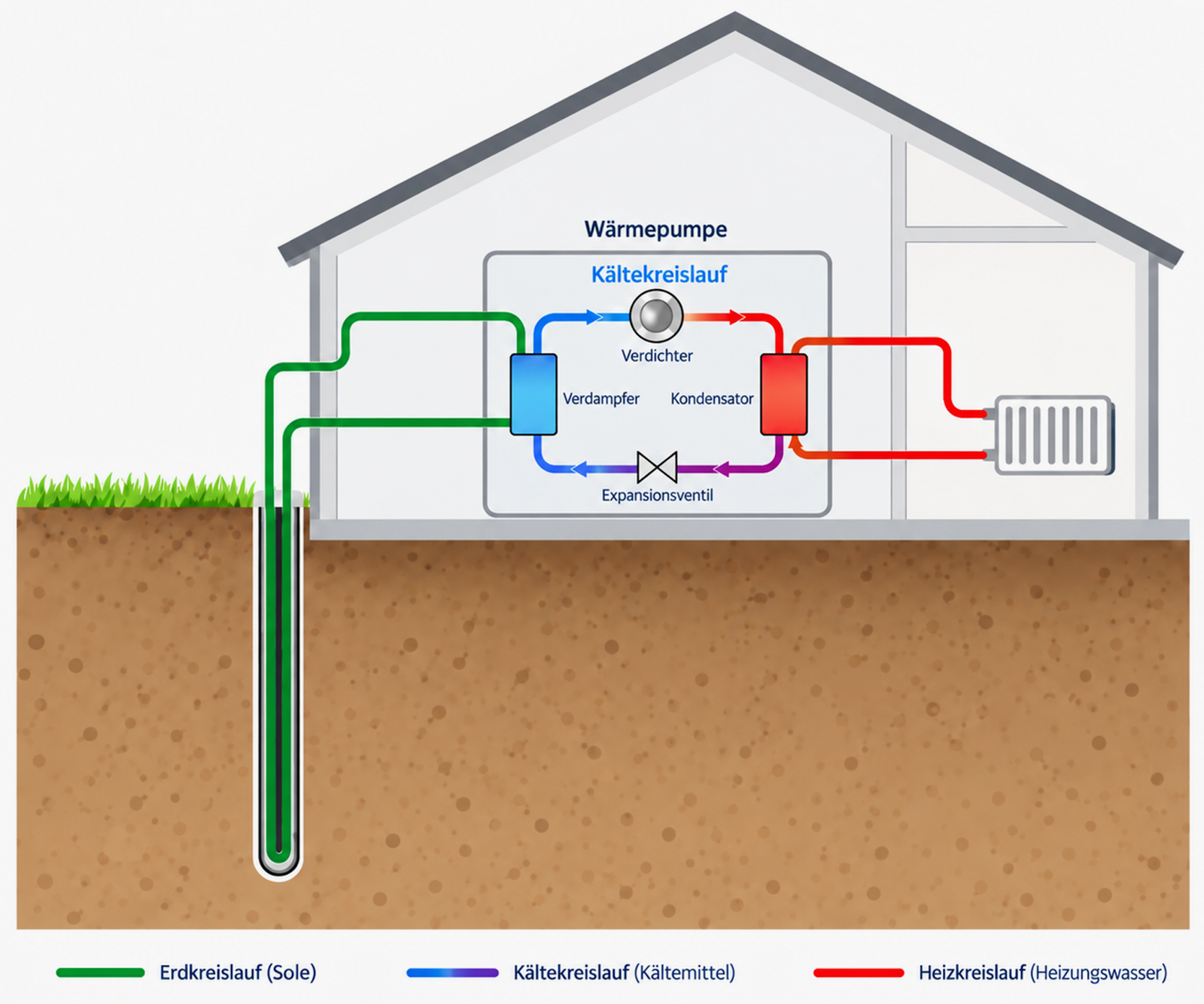
A geothermal heat pump uses heat from the subsurface and raises it to a temperature level that can be used for heating and hot water. Technically, this is done via three interconnected circuits.
The basic principle can be explained with a velo pump: When pumping up, air is highly compressed. The air and the pump heat up. If a gas is subsequently expanded, its temperature drops. This connection between pressure and temperature is also used by a heat pump. In addition, evaporation and condensation occur in their closed refrigerant circuit.
A geothermal heat pump, usually referred to technically as brine-to-water heat pump, extracts heat from the soil at a low temperature level. The refrigerant circuit raises this temperature level and then transfers the heat to the heating system of the building.
The three circuits of a geothermal heat pump
Earth cycle
A heat transfer fluid, the so-called brine / heat transfer fluid, circulates in the earth circuit. It flows through the borehole heat exchanger (BHE), absorbs heat from the substrate and transports it to the heat pump. There it releases the heat to the refrigerant circuit and flows back into the probe.
With separatus, a compact borehole heat exchanger (BHE) with 51 mm external diameter takes on this task. For the schematic illustration, a drilling diameter of 108 mm is used. The earth circuit remains hydraulically separated from the refrigerant circuit.
Cold circuit
In the evaporator, the refrigerant absorbs heat from the brine / heat transfer fluid and evaporates. The compressor compresses the refrigerant vapor; Pressure and temperature increase. In the condenser, the refrigerant releases the heat to the heating water and becomes liquid again. The expansion valve then lowers the pressure. The refrigerant cools and reaches the evaporator again.
Heating circuit
The heating circuit distributes the heat generated in the building. The heated heating water flows, for example, through a floor heater or existing heaters, releases heat to the rooms there and returns cooled to the heat pump.
How deep must the bore for geothermal energy be?
There is no blanket drilling depth. It is adapted to the building’s heat demand and geological conditions. Crucial are, among other things, thermal conductivity of the subsoil, groundwater conditions, possible drilling depth and regulatory requirements.
For classification: EnergieSchweiz lists 100 to 300 m as the usual standard depth for borehole heat exchangers in Switzerland. The Federal Association of Geothermal Energy often names 50 to 160 m for Germany. These areas are not universal design values, but show that the drilling depth must be determined regionally and project-specifically.
borehole heat exchanger (BHE) or Earth collector?
Geothermal collectors are usually laid horizontally at approximately 1,2 to 1,5 m depth. There, seasons, precipitation and solar radiation influence the heat source temperature more strongly. Geothermal probes reach much deeper and provide a thermally more stable heat source over the year. They also require less space on the surface.
Can a geothermal heat pump also cool?
Yes. geothermal energy and groundwater heat pumps can cool buildings passively especially easily. The compressor of the heat pump remains switched off. Circulating pumps transport excess heat from the building to the cooler underground. As a result, temperature control is carried out with comparatively little electrical energy.
What are the disadvantages of a geothermal heat pump?
A geothermal heat pump has higher initial costs than many simpler heating systems, because the heat source in the underground must first be developed. In addition, borehole heat exchangers are not authorized at every location or geologically meaningful. Heat requirements, drilling depth and borehole heat exchanger system must be coordinated professionally.
Conclusion
A geothermal heat pump brings heat from the subsurface into the building via three separate circuits. The brine / heat transfer fluid transports the geothermal energy to the heat pump, the refrigerant circuit raises the temperature level and the heating circuit distributes the heat in the house. Decisive are a suitable dimensioning of the borehole heat exchanger (BHE), the geology and the space conditions on the property.
Sources
Harvard Natural Sciences Lecture Demonstrations; Federal Environment Agency Germany; Switzerland Energy; Federal Office for Energy; Bundesverband Geothermie.